Heart Sutra (Hannya Shingyo)
The Heart Sutra (Sanskrit: Prajnaparamita Hridaya) is arguably the most essential text of Mahayana Buddhism and succinctly summarizes the teaching of the “Perfection of Wisdom.” Its core is the radical realization of emptiness (Shunyata), according to which nothing exists independently of itself, but everything is in deep interdependence with one another.
Form is emptiness, emptiness is form
The most famous line of the Heart Sutra is “Form is emptiness, emptiness is form.” In the context of our Zen practice, this is not an abstract philosophical puzzle but a precise description of reality. When we speak of “emptiness” in Zen, we do not mean nihilism—it is not that “nothing exists.” Rather, it means that all phenomena are empty of a separate, permanent self-nature.
Imagine a wave in the ocean: it has a form, a height, and a direction. But it is not separate from the ocean. It is water. When the wave dissolves, the form disappears, but the water remains. So it is with all things, and with ourselves as well. We are a temporary form of emptiness that expresses itself as a human being in this moment. In the Rinzai tradition, this insight is not merely discussed intellectually but must be directly experienced in meditation (Zazen). The goal is to break through the identification with the small, isolated “I.”
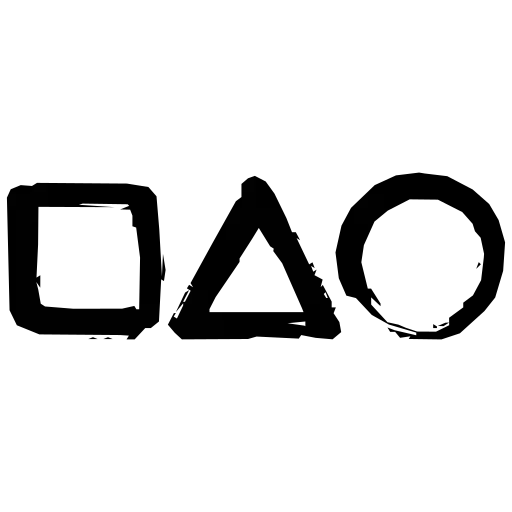
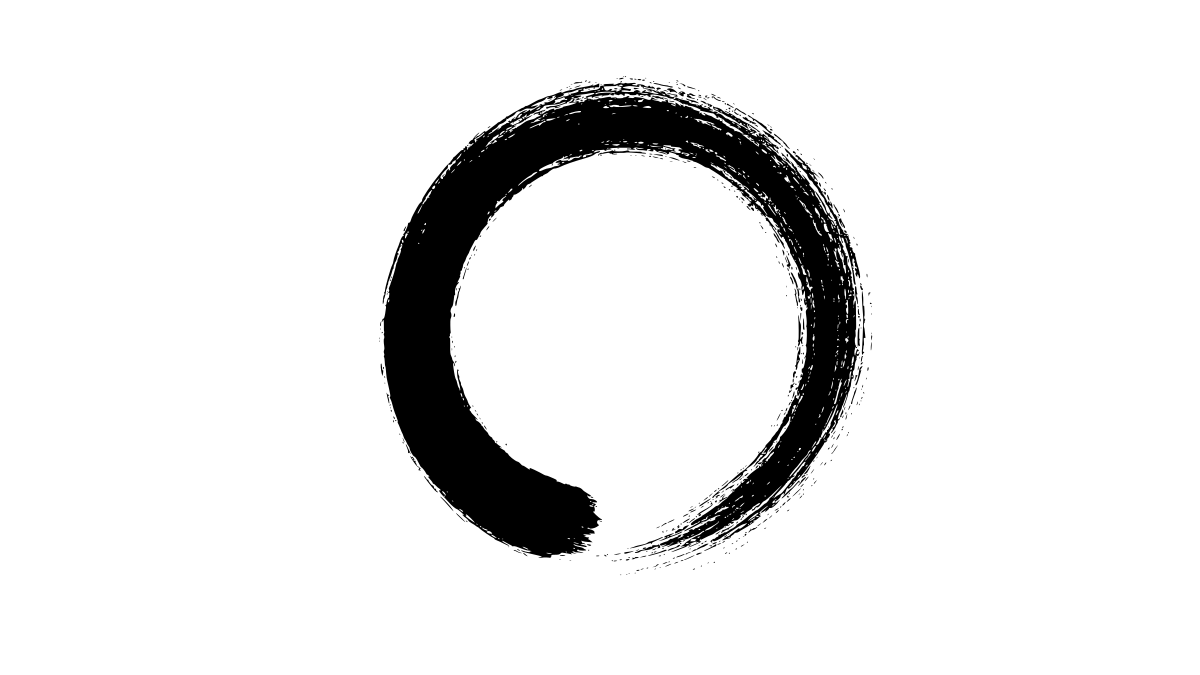
A powerful visual symbol of this truth is the Enso, the Zen circle. In a single, decisive brushstroke, the interplay of form and emptiness becomes immediately visible: the black line (form) gives the emptiness within a boundary, thereby making it tangible. At the same time, the emptiness inside the circle is identical to the emptiness outside. The circle is often left open, emphasizing the imperfection and constant flow of reality. In Rinzai Zen, painting an Enso is a moment of absolute presence—a direct expression of the Heart Sutra, entirely without words.
The Role in Rinzai Zen
In our daily ceremonies and in the zendo, the Hannya Shingyo (the Japanese name of the sutra) is almost always recited. The powerful, rhythmic chanting on a single note serves to quiet the discursive mind. It is less about reflecting on the text while singing, and more about total surrender to the sound and the breath. The sutra thus becomes an energetic tool that helps us enter the state of “not-knowing.”
An interesting aspect of the Rinzai school is the uncompromising negation of all concepts in the text. The sutra states, “No eye, no ear, no nose, … no ignorance, no end of ignorance, … no path, no realization, and no attainment.” This is an invitation to let go of all concepts. Even the most sacred teachings of Buddhism (such as the Four Noble Truths) are “negated” here to prevent us from clinging to words instead of seeking the living truth behind them.
Application in Practice and Koan Work
In koan training, you encounter the Heart Sutra indirectly time and again. When a teacher asks you, “What is your original face, before your parents were born?” this points directly to the emptiness described in the sutra. Wisdom (Prajna) here does not mean knowing a lot, but rather the ability to see the world without the filters of our prejudices and categories.
The sutra ends with a mantra often referred to as the “great liberating phrase”: Gate gate paragate parasamgate bodhi svaha. Translated, this means, “Gone, gone, gone across, completely gone across to the shore of awakening.”
For you as a practitioner, this means Zen is not a static affair. It is a constant process of “crossing over.” You leave old notions of yourself behind on one shore and step courageously into the openness of emptiness. The Heart Sutra does not offer you a new ideology for this, but rather the courage to live fully in the incomprehensibility of the moment. It reminds you that right where you are now—in your daily form, in your everyday life—the absolute freedom of emptiness is already present.
English Translation
The Heart Sutra
We recite the Heart Sutra:
Bodhisattva Avalokiteshvara, through the insight gained in deep meditation, examined the five skandhas¹⁻⁵—the sources of existence—and saw that they are all empty. Filled with this clarity, she overcame all suffering. In the presence of the Buddha and his assembly, she shared her insights as follows:
Listen, Shariputra: form¹ is emptiness, emptiness is form. Form is no different from emptiness; emptiness is no different from form.
This also applies to feelings,² perceptions,³ impulses,⁴ and consciousness.⁵
Thus, Shariputra, all things are characterized by emptiness; they neither arise nor cease; they are neither pure nor impure; they neither decrease nor increase.
Therefore, in emptiness there is:
- no form, no feeling, no perception, no impulse, no consciousness;
- no eye, no ear, no nose, no tongue, no body, no mind;
- no form, no sound, no smell, no taste, no touch, no object of the mind;
- no ignorance, no end of ignorance; no aging and death, no end of aging and death;
- no suffering, no cause of suffering, no end of suffering; no path, no realization, no attainment.
Because there is no attainment, the one who possesses perfect insight experiences no obstacles in the mind. Without obstacles in the mind, we overcome all fear, free ourselves from illusions, and realize Nirvana.
Thanks to this perfect wisdom, all Buddhas of the past, present, and future attain the highest enlightenment.
Therefore, realize that this perfect wisdom is a mighty mantra, the destroyer of all suffering, the irrefutable truth. This mantra is:
“Gate Gate Paragate Parasamgate Bodhi Svaha”
Gone, gone, gone to the other shore, gone together to the other shore. The great awakening, energy, and happiness for all.
This is the Heart Sutra
Japanese Recitation (Rōmaji)
MA KA HAN NYA HARA MI TA SHIN GYO
KAN JI ZAI BO SA GYO JIN HAN NYA HA RA MI TA JI SHO KEN GO ON KAI KU DO IS SAI KU YAKU SHA RI SHI SHIKI FU I KU KU FU I SHIKI SHIKI SOKU ZE KU KU SOKU ZE SHIKI JU SO GYO SHIKI YAKU BU NYO ZE SHA RI SHI ZE SHO HO KU SO FU SHO FU METSU FU KU FU JO FU ZO FU GEN ZE KO KU CHU MU SHIKI MU JU SO GYO SHIKI MU GEN NI BI ZES SHIN NI MU SHIKI SHO KO MI SOKU HO MU GEN KAI NAI SHI MU I SHIKI KAI MU MU MYO YAKU MU MU MYO JIN NAI SHI MU RO SHI YAKU MU RO SHI JIN MU KU SHU METSU DO MU CHI YAKU MU TOKU I MU SHO TOK KO BO DAI SAT TA E HAN NYA HA RA MI TA KO SHIN MU KE GE MU KE GE KO MU U KU FU ON RI IS SAI TEN DO MU SO KU GYO NE HAN SAN ZE SHO BUTSU E HAN NYA HA RA MI TA KO TOKU A NOKU TA RA SAN MYAKU SAN BO DAI KO CHI HAN NYA HA RA MI TA ZE DAI JIN SHU ZE DAI MYO SHU ZE MU JO SHU ZE MU TO DO SHU NO JO IS SAI KU SHIN JITSU FU KO KO SETSU HAN NYA HA RA MI TA SHU SOKU SETSU SHU WATSU
GYA TEI GYA TEI HA RA GYA TEI HA RA SO GYA TEI BO JI SO WA KA
HAN NYA SHIN GYO
Read more about the Heart Sutra
Delve deeper into the world of the Heart Sutra. In the following articles, you can discover how this concept comes to life in different contexts and what new dimensions it can bring to your own practice.
Das Herz-Sutra
Meine Erleuchtung und das Ego
Das Herz-Sutra
Die Freiheit der Leere

Wie das Herz-Sutra dich gegen böse Geister schützt