This thinking model (developed by Zen Master Rients Ritskes) visualizes the different levels of our consciousness. It illustrates how unprocessed experiences unconsciously influence our actions and how we can clarify the mind through Zen meditation.
The Five Levels
To explain in simple terms how Zen meditation works and takes effect, the model divides our mind and its expression into five layers.
From Bubbles to Dots
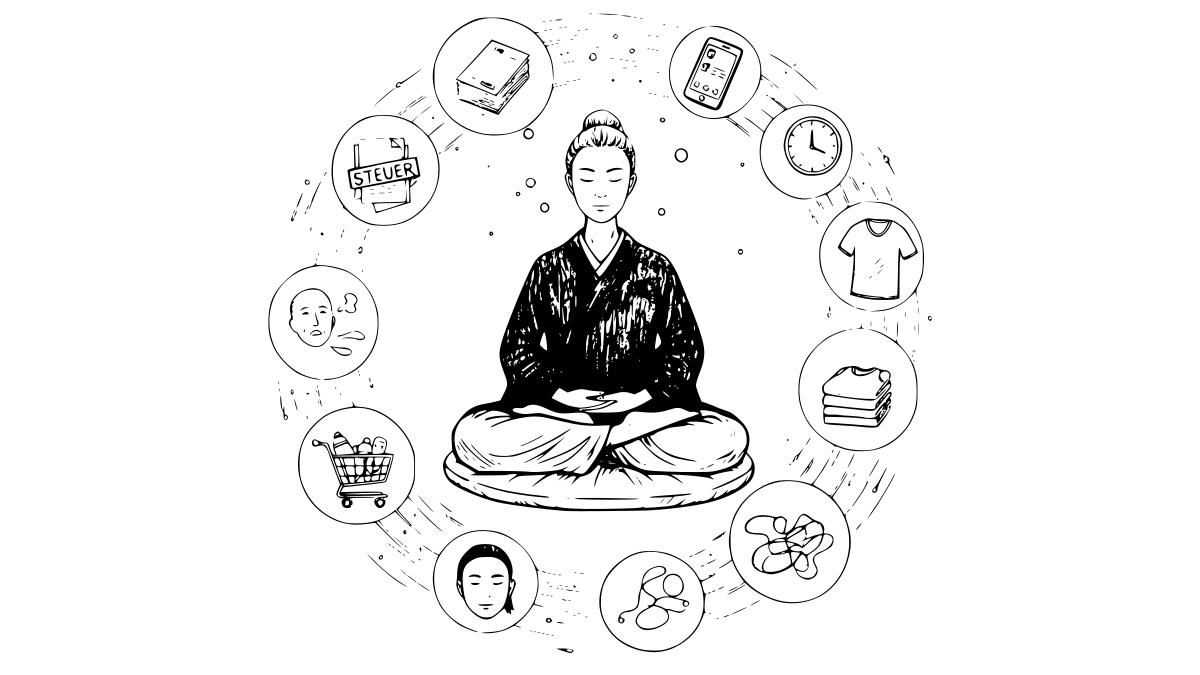
We refer to everything that distracts us during meditation as bubbles. They are neutral in themselves. They can relate to both negative and positive experiences, as well as the past or the future. A simple example is a beautiful advertisement for a trip that you saw during the day and think about during meditation. This experience is still unprocessed in the sense that you haven’t yet decided whether you want to pursue it or not. Successes, just like failures, must be processed. If you cling to an old formula for success and try to repeat it over and over again like a trick that once worked, it blocks your view of new possibilities.
Bubbles are not a problem in themselves; everyone has them. It only becomes burdensome when there is an excess. Too many bubbles make life difficult, cloud our perception through projection, and lead to our barely being able to concentrate. Processed experiences, on the other hand, we call “dots.” They are available to us as pure insight and no longer burden us emotionally.
The Process of Allowing
In everyday life, bubbles often manifest as vague frustration or distraction. During Zen meditation (Zazen), they push their way into our consciousness. How exactly does this work?
By counting our breaths (Susokukan), we keep the cognitive part of our brain occupied. This helps us simply allow the rising bubbles—whether memories or desires—to arise and observe them, rather than actively fighting them or trying to analyze them.
In everyday life, we often notice that we are distracted, forget things, or cannot concentrate. But it is only through meditation that we recognize the actual bubble behind this distraction. We often see through smaller bubbles quickly during meditation—such as a task we’ve been putting off for a long time. The realization that it’s distracting us leads us to complete it and thus get rid of this small bubble. With larger bubbles, it takes longer to see through them, and they keep resurfacing.
It’s like watching a movie multiple times: with each viewing, we see more until we’ve fully seen through the bubbles, and they enter our consciousness as insights. Through this acceptance and nonjudgmental observation, the bubbles naturally transform into tiny dots. In this way, unprocessed experiences become a source of insight and inspiration.
Freedom and Clarity in Everyday Life
These insights no longer disrupt your concentration. The more bubbles turn into dots, the clearer the mind becomes, deepening your focus. You regain control over your thoughts—not through thinking or even brooding, but through the natural process of processing by allowing them to be during meditation. This is how we learn, step by step, to think what we want to think and to lead a self-determined life.
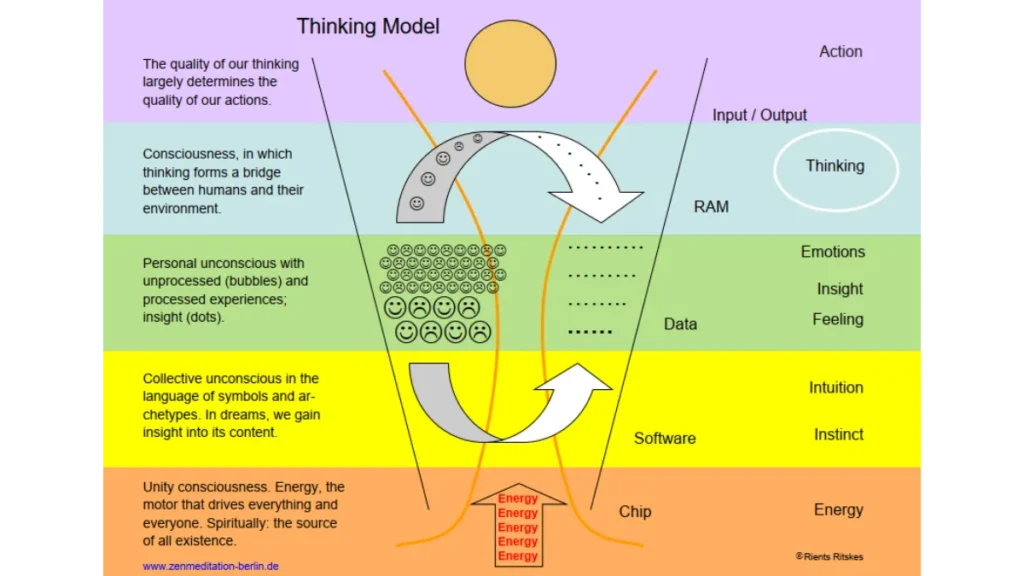
It shows how, through meditation, we process our “bubbles” (unprocessed experiences) into “dots” (insights).
Abonniere den Zenletter
Jeden Freitag schlage ich die Brücke zwischen traditionellen Zen-Anekdoten und der heutigen Realität. Neue Blickwinkel – inklusive Direktlink zum neuesten Blogbeitrag.
Wohnst du in Berlin?
Lerne die Praxis und Wirkung im nächsten Einführungskurs unverbindlich kennen – inklusive kostenloser Probestunde.
Read more about Bubbles & Dots
In these articles, you’ll find examples of how bubbles influence life and how to transform them into inspiration. Note: The articles are in German but can easily be read using your browser’s auto-translate feature.

Das Spiel mit dem Scheitern

Buddhas Mittelweg
Bubbles und der Zeigarnik-Effekt
Meine Erleuchtung und das Ego
Von unbewussten Ängsten zu klaren Zielen